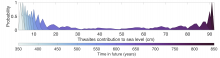
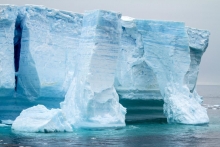
Ice sheets have gone through periods of rapid melting, causing sea level to rise many times faster than the current rate of rise. Some of these rapid melting events have occurred during periods when ocean and atmospheric temperatures were at or just above modern temperatures. It is thought that there are instabilities intrinsic in the dynamics of ice sheet flow and melting that may cause such rapid sea level rise events, even without changing climate.
Advection and biological consumption are both important sinks for oil and gas released from natural seeps in the Gulf of Mexico. We will use a combination of stable isotope measurements and high resolution modeling with both passive and positively buoyant tracers to study the interaction between physical and biological processes in distributing and transporting the carbon released from natural seeps. We will focus on three major seep fields in the Northern Gulf with different water depths –GC185 (ca. 400 m), GC600 (ca. 1200 m), and GC767 (ca.
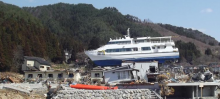
Many densely populated coastal areas around the world are low lying and susceptible to relative sea level rise (SLR) associated with climate change, land level subsidence or tectonic subsidence. Coastal defense structures have been constructed as barriers to certain design storm surge, storm wave or tsunami heights. Typically even without SLR the design criteria change over time as hazards get reanalyzed or remodeled. The decrease in risk reduction due to relative SLR and the performance of existing defense barriers under loading conditions beyond the design need to be determined.
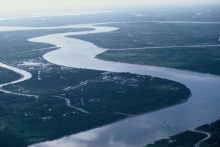
The exponential growth of human populations in the Mekong-South China Sea (SCS) system, the eutrophication of estuarine and coastal waters by excess nutrients transported by the Mekong River, and the rapid sinking of the Mekong Delta are fundamentally changing the biological productivity and biodiversity of the system, with uncertain implications these aquatic resources. In the near future, larger forcings will alter the linkages between the Mekong system and the SCS basin.
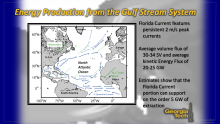
The recently completed resource assessment for ocean current energy (Haas et al. 2013) utilized fairly simplistic analytical methods to estimate the extractable energy from the Gulf Stream System as well as to analyze the relative impacts of large scale energy extraction. This level of analysis can be considered to be accurate to an order of magnitude and only provides an idea on the overall trends of the impacts of extraction. Much higher resolution modeling is required to accurately determine the overall impacts of extraction for both localized and far field effects.
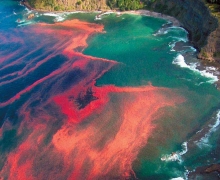
Single-celled marine algae are especially chemically rich, producing toxins that kill fish, marine mammals, and seabirds, contaminate shellfish, and threaten human health. Many predators of these algae – copepods – selectively consume less toxic algae, which in turn sense copepods via an excreted blend of copepod-specific molecules. These algae then become up to 20X more toxic when they sense copepod cues in the open ocean.
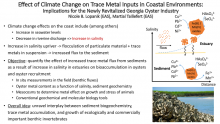
The effects of climate change on the coastal ocean include a decrease in riverine inputs and increase in salinity in estuaries with impacts on primary production, macrofauna, and sediment biogeochemistry that are poorly understood. One clear effect of the increase in salinity associated with the decrease in riverine discharge, however, is the enhanced coagulation of inorganic material further upriver. Flocculation of particulate material upriver will enhance its flux to the sediment and simultaneously decrease the outflux of particulate material to the continental shelf.
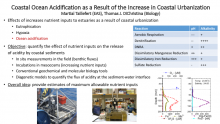
The urbanization of the coast is generating significant environmental issues, including increasing nutrient runoff that promotes eutrophication and hypoxic conditions in estuaries. At the same time, the excessive input of nutrients is also responsible for an increase acidification of coastal waters, as denitrification in sediments typically generates acidity.
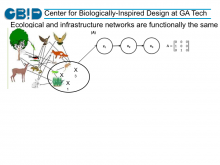
Creating sustainable and resilient cities depends on understanding the properties of food, energy, water and other infrastructure networks. Ecological network analysis ENA is a tool that can be used to understand the connections between network structure, material and energy flow, and resilience. ENA is increasingly applied to both understand and design more sustainable and resilient human infrastructure.